
Table of Contents
Finding the right hot melt adhesive for your application is one thing, but dispensing it is another. The hot melt equipment you use needs to match the shape of your adhesive as well as your production needs. The wrong equipment could slow down your production, lead to inconsistencies, or drain your budget unnecessarily.
To help you find the right setup for your operation, our team is breaking down the different types of hot melt equipment for dispensing, including their pros, cons, and ideal use cases.
How Hot Melt Glue Dispensing Works
Different hot melt adhesive dispensing systems and equipment come in a range of sizes, are compatible with different production volumes, and have various levels of automation. While there are multiple methods of hot melt dispensing, the equipment generally follows the same core principles for application.
Instead of relying on solvents to cure, hot melt adhesives typically rely on temperature changes. These thermoplastic adhesives are heated until they turn from a solid to a liquid. Applied as a liquid, hot melts will solidify and harden as they cool to form bonds.
Main Types of Hot Melt Dispensing Systems
Because there are so many different hot melt adhesive dispensers and systems to choose from, it can be hard to know where to even begin. To help simplify your decision, our team breaks down some of the main categories of hot melt dispensing equipment, including:
- Hot Melt Glue Guns and Applicators
- Bulk Hot Melt Melters and Tanks
- Hot Melt Pail and Drum Unloaders
- Automated and Robotic Dispensing Systems
Hot Melt Glue Guns and Applicators

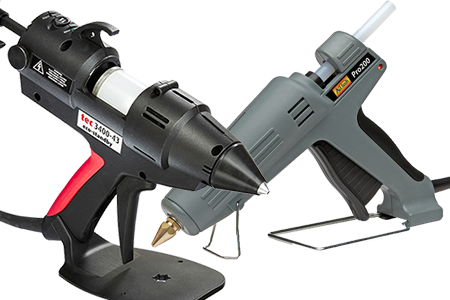
Hot melt glue guns or applicators are designed for the manual application of hot melt adhesive in lower volumes or flexible operations. These handheld tools rely on operators to apply the adhesive.
Standard hot glue guns use glue sticks, but there are also industrial-grade glue guns that use hot melt glue slugs for higher output applications or longer run times. Depending on the model, glue guns can be battery-powered, electrically powered, or pneumatic. Most hot glue guns use extrusion (bead) dispensing, but there are some models that are capable of spray application for broader coverage.
While hot glue guns are what come to mind for craft and DIY projects, they are also commonly used in light industrial, packaging, and repair applications. They are especially useful for applications that require flexibility. Some top brands of hot melt glue guns include Power Adhesives, 3M, and Infinity Bond.
Pros:
- Easy to operate, minimal training required
- Lower cost
- Flexible and portable
Cons:
- Precision and accuracy rely on the operator
- Not good for high volume or continuous dispensing
Shop our diverse collection of hot melt glue guns.
Bulk Hot Melt Melters and Tanks

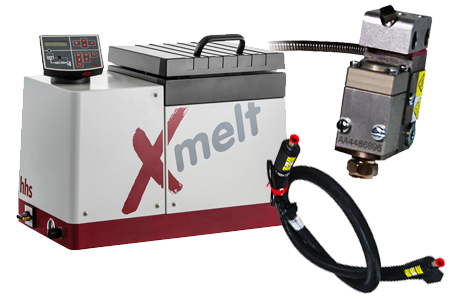
Bulk hot melt tanks and glue machines are used to heat bulk forms of hot melt adhesive and provide controlled and consistent dispensing for higher volume applications. These systems have a higher output than glue guns and are typically used in industrial environments where steady output and reliable adhesive flow are required.
Traditional tank systems use reservoirs to melt and hold adhesive before it is pushed through the rest of the systems for dispensing. Many modern bulk systems, like the Graco InvisiPac glue machines, are tankless and use melt-on-demand technology to minimize the amount of adhesive held at temperature and decrease adhesive charring. Melter sizes and configurations vary, so it is important to use one that matches production volume and adhesive requirements. Top brands of bulk hot melters include Graco, Nordson, and Meler.
Pros
- Consistent adhesive temperature and flow
- Supports higher production volumes or longer production runs
- Reduces manual handling compared to handheld systems
- Can integrate with automated dispensing equipment
Cons
- Higher upfront cost than handheld systems
- Requires regular maintenance
- Less portable than manual equipment
Browse our wide collection of hot melt units.
Hot Melt Pail and Drum Unloaders

Hot melt pail and drum unloaders are designed to process large volumes of adhesive directly from containers such as 5-gallon pails or 55-gallon drums. Instead of manually loading smaller amounts of adhesive into a melter, these systems feed and melt adhesive from large containers using either continuous or platen-based processes. They are ideal for higher-volume or continuous operations where efficiency, consistency, and reduced downtime are critical.
We often recommend pail and drum unloaders for manufacturers looking to scale production, improve efficiency, or support continuous processing. Top brands include Graco and Meler.
Pros:
- Supports very high production volumes
- Minimizes downtime from refilling
- Improves process consistency and efficiency
- Integrates well with automated systems
Cons:
- Higher initial investment
- Requires more floor space
- Less flexible for small or intermittent applications
See our options for hot melt pail and drum unloaders.
Automated and Robotic Dispensing Systems

Automated and robotic dispensing systems are designed to deliver hot melt adhesive with high precision and repeatability in production environments. These systems integrate melters, hoses, and applicators with programmable controls, conveyors, or robotic arms to automate the application process.
They are commonly used in manufacturing environments where consistency, speed, and accuracy are critical. By reducing reliance on manual application, these systems help improve quality and streamline production.
Pros:
- Highly consistent and repeatable results
- Increases production efficiency and throughput
- Reduces adhesive waste and improves accuracy
- Minimizes operator error and variability
- Integrates with existing production lines and controls
Cons:
- Higher upfront investment
- Requires programming and technical expertise
- Less flexible for low-volume or frequently changing applications
See robot dispensing systems from benchtop machines to cobots.
Comparison of Hot Melt Equipment Types
Now that we have covered each type of hot melt adhesive dispensing equipment, it is important to look at how they compare. The table below highlights some of the key differences in the hot melt equipment as well as their ideal use cases to help you find the right one for your needs.
| Equipment Type | Key Properties | Ideal Uses |
|---|---|---|
| Hot Melt Glue Guns | Manual, portable, low output | Repairs, light assembly, packaging, maintenance |
| Melters & Tanks | Consistent heating, moderate to high output | General manufacturing and packaging lines |
| Pail & Drum Unloaders | Bulk capacity, continuous operation | High-volume production and long run times |
| Automated/Robotic Systems | Programmable, high precision, repeatable | Complex, high-speed manufacturing environments |
While each type of hot melt dispenser serves a distinct purpose, it is important to understand that you may benefit from using more than one type of equipment depending on your operation. The ideal setup depends on your specific needs, and it is also not uncommon for your needs to change, so you should keep that in mind when selecting hot melt equipment.
How to Choose the Right Hot Melt Dispensing Equipment
When selecting a kind of hot melt adhesive dispenser, it is important to think about multiple factors, including:
Adhesive Type
Different chemistries and different forms of hot melt require different equipment and handling.
Production Volume
Your output requirements will heavily influence your equipment choice. Lower-volume applications may only need handheld glue guns, while higher-volume operations often require tank melters, pail and drum unloaders, or robotic systems to maintain consistent flow.
Application Method
Consider how the adhesive needs to be applied. Bead, spray, and coating applications each require different applicators and system configurations. Choosing the wrong method can lead to waste, poor bond quality, or inconsistent results.
Level of Automation
Think about how much manual involvement your process can handle. Manual systems offer flexibility, while automated systems improve consistency and throughput. The right balance depends on your production speed and repeatability requirements.
Maintenance and Uptime
Reliable equipment is critical for minimizing downtime. Look for systems that are easy to clean, service, and maintain. Regular maintenance requirements, part availability, and ease of troubleshooting should all factor into your decision.
Future Needs
If you expect your production to increase, choose equipment that can scale with your operation. Upgrading from a handheld system to a bulk or automated setup can be costly, but it could lead to great long-term returns.
Need Help?
Whether you are running a small packaging line or a high-volume manufacturing process, you need the right equipment. While you may have a better understanding of the type of hot melt dispensing equipment you need, the next step is determining the specific model and setup. Fortunately, our team can provide you with personalized equipment recommendations based on all your needs. Contact us to get connected to an equipment expert.
Hotmelt.com is not affiliated with the Nordson® Corporation. All OEM part numbers are for reference only. Nordson® is a registered trademark of the Nordson® Corporation.