
Table of Contents
- About Henkel Technomelt Supra 100
- Benefits
- Limitations
- Our Review of Technomelt Supra 100
- When to Use
- FAQs
Numerous packaging adhesives are available, but the right one should meet your application, production, and budget requirements. One popular option of packaging adhesive is Technomelt Supra 100 from Henkel.
With more than 50 years of experience in the hot melt adhesive industry, we have evaluated products from a wide range of brands across numerous applications. In this article, we review Henkel Technomelt Supra 100, including its strengths, limitations, and ideal uses.
About Henkel Technomelt Supra 100
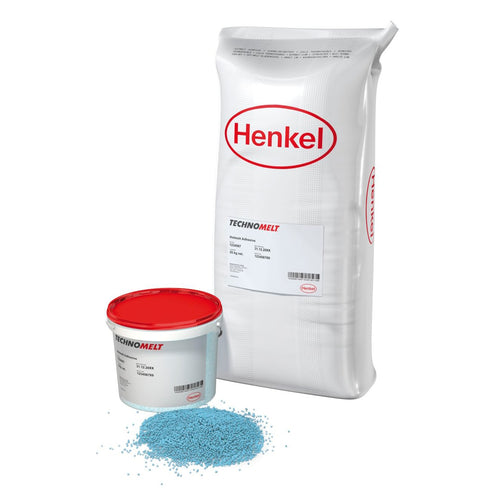
Henkel Technomelt Supra 100 is a fast-setting polyolefin hot melt adhesive commonly used for packaging applications like case and carton sealing or tray forming. With an open time of about 5 to 7 seconds, a set time of about 1 to 2 seconds, and a high molten tack, the Supra 100 is compatible with high-speed packaging lines.
The adhesive can bond a range of paper and paperboard packaging materials, including printed and lacquered surfaces. It is white in its solid form but melts clear.
A few other specifications for the Technomelt Supra 100 hot melt are outlined below.
|
Property |
Specification |
|
Viscosity (Brookfield) |
Approx. 1,200–1,600 cP at 320°F (160°C) |
|
Working Temperature |
325–375°F |
|
Recommended Application Temperature |
350°F |
|
Softening Point |
223°F |
|
Solid Content |
100% |
|
Compliance |
FDA 21 CFR 176.170 FDA 21 CFR 176.180 FDA 21 CFR 175.105 |
These values represent typical product specifications. Actual performance can vary based on the substrate, adhesive temperature, application amount, compression, production speed, and environmental conditions.
Benefits
Henkel Technomelt Supra 100 offers several notable advantages for packaging operations, including:
- Fast set time for high-speed packaging lines
- Strong adhesion and high molten tack
- Good cold flexibility
- High heat resistance
- High thermal stability that may reduce charring
- High mileage characteristics for lower adhesive consumption
- Compatible with printed and lacquered packaging surfaces
- Meets FDA requirements for certain direct and indirect food-contact packaging applications
Limitations
Despite its many benefits, Technomelt Supra 100 may not be the best fit for every operation. Some potential limitations of the Supra 100 adhesive are listed below.
- Requires compatible hot melt dispensing equipment
- Fast set time may not be suitable for applications that require additional positioning or assembly time
- Requires relatively high operating temperatures
Our Review of Technomelt Supra 100
Overall, the Technomelt Supra 100 from Henkel is a great choice for high-speed packaging operations that need a reliable, fast-setting hot melt adhesive. Its ability to bond to printed and lacquered packaging surfaces, combined with its resistance to hot and cold temperatures, makes it a versatile adhesive solution for case sealing, carton sealing, tray forming, and wrap-around cases. It also meets FDA requirements for certain food-contact packaging applications, so it is a good option for many food and beverage operations.
Supra 100’s high mileage and thermal stability may also help packaging operations control adhesive consumption and support cleaner equipment performance. These characteristics can be particularly valuable for facilities running automated lines for extended periods.
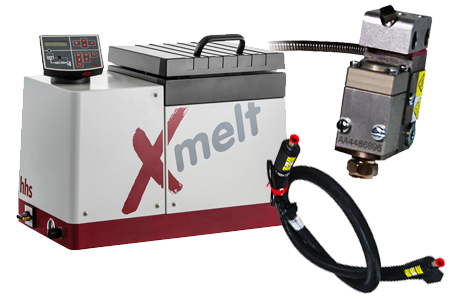
It is important to note that the Technomelt Supra 100 hot melt adhesive requires a compatible hot melt tank and dispensing system for application. If you do not already have the necessary equipment, this requirement can significantly increase your startup costs. The short open time and fast set time also make the adhesive less suitable for slower packaging lines or applications that require additional time to position components.
When to Use
The Technomelt Supra 100 packaging adhesive can form strong bonds with a wide range of papers and boards. It is most commonly used in packaging applications like gluing wrap-around cases, tray forming, case sealing, and carton sealing.
Technomelt Supra 100 may be a good fit when your operation needs:
- A fast-setting adhesive for an automated packaging line
- Strong initial tack to hold packaging components in place
- Reliable adhesion to printed or lacquered surfaces
- Performance across hot and cold conditions
- An adhesive for packaging that may be exposed to deep-freeze conditions
- High mileage to help control adhesive consumption
- One adhesive for multiple case, carton, and tray applications
Before selecting an adhesive, you should compare its open time, set time, and working temperature with your line speed and existing equipment. The best way to determine whether Technomelt Supra 100 is appropriate for your application is to test it using your packaging materials and normal production conditions.
Find the Right Adhesive
If you are not sure whether Technomelt Supra 100 meets your application requirements or are looking for an alternative, we may be able to help. At Hotmelt.com, we have an extensive line of hot melt adhesives for packaging, as well as the expertise to help you find the best option for your needs. Contact our team to discuss your application and get a personalized product recommendation.