
Chemistry isn't the only important part of hot melt selection. The format of the adhesive itself can also have a huge impact on your production. Hot melt glue sticks and hot melt glue slugs are two popular forms of adhesive, but they are best suited for very different production needs. Using the wrong form can slow down your production process, waste material, or increase your overall costs.
Regularly working with manufacturers, operators, and maintenance teams, we understand these different needs. We share the differences between hot glue sticks and hot glue slugs, as well as how to choose between the two.
What Are Hot Melt Glue Sticks?
Hot melt glue sticks, or just glue sticks, are the familiar cylindrical sticks of adhesive that you feed into a standard hot glue gun. The traditional hot glue stick has about a ½-inch or 12 mm diameter and can fit in your standard craft glue gun. There are also different size industrial glue sticks, like 5/8-inch sticks, as well as specialty sticks like Q, TC, or PG sticks.
While commonly associated with craft projects, glue sticks are also widely found in industrial applications because they are easy to use and great for low-volume production. They require minimal equipment investment and come in numerous chemistries, including EVA, polyolefin, polyamide, pressure-sensitive, and more. Their versatility and ease make them a practical choice for many light manufacturing and maintenance tasks.
What Are Hot Melt Glue Slugs?
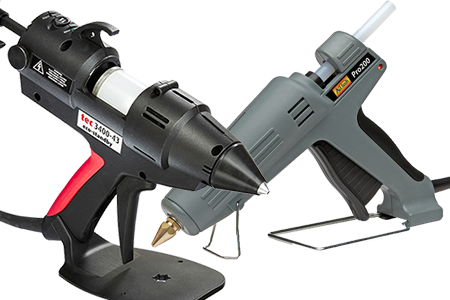
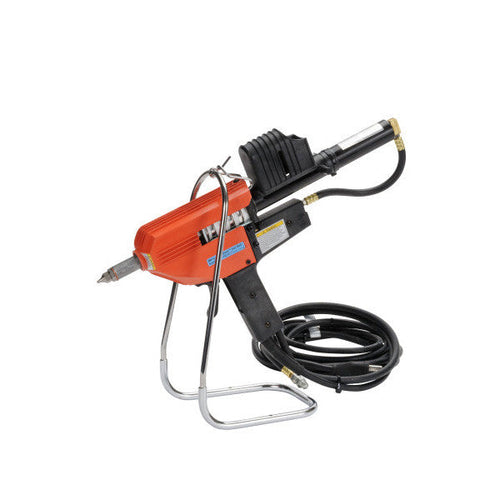
Hot melt glue slugs are a larger form of hot melt adhesive. Like traditional glue sticks, glue slugs still take a cylindrical stick shape, but they feature a wider diameter, typically around 1¾ inches. Hot glue slugs are generally used when production demands are higher and more throughput is needed. They have much higher melt and dispense rates, and they require fewer reloads during operation compared to glue sticks.
Hot melt glue slugs cannot be used with a standard glue gun but instead require a compatible industrial glue gun for proper application. Like glue sticks, glue slugs are available in multiple chemistries and with different product specifications depending on your needs.
Glue Sticks Vs. Glue Slugs: Key Differences
It is a common misconception that glue slugs provide a stronger bond than glue sticks. In reality, the bond strength and overall performance specifications are determined by the adhesive’s formulation, not its format or shape. In fact, a lot of manufacturers will offer the same adhesive with the exact same properties in both forms.
So, the key difference between hot glue sticks and hot glue slugs is not about adhesive performance, but rather their application. The chart below helps explain this difference in more detail.
| Property | Glue Sticks | Glue Slugs |
|---|---|---|
| Adhesive Output | Low to moderate | Higher |
| Equipment Type | Standard handheld or benchtop glue guns | Industrial, high-output glue guns |
| Reload Frequency | More frequent | Less Frequent |
| Operator Involvement | Higher, may lead to operator fatigue | Lower, can help decrease operator fatigue |
| Ideal Production Volume | Low | Medium to high |
While both hot melt glue sticks and glue slugs can offer great adhesive performance, the differences come down to how they impact the dispensing and application process.
Compared to glue slugs, hot melt sticks have a lower adhesive output that is more compatible with lower-volume or intermittent dispensing applications. The advantages of glue sticks are that they are easy to dispense and use a standard glue gun. On the flip side, using glue sticks for higher-throughput applications means frequent reloading that can waste time and lead to operator fatigue.
Hot melt glue slugs, on the other hand, are better for higher-volume applications because they can dispense more adhesive before needing to reload. This setup can reduce operator fatigue as well as unnecessary downtime. Especially for adhesive applications that are continuous, glue slugs can save operators and businesses a significant amount of time. If you already have an adhesive that performs well in glue stick form, switching to a slug version can improve efficiency without changing bond performance.
How to Choose Between Glue Slugs and Glue Sticks
When comparing glue sticks and glue slugs, you should consider the following:
Adhesive Volume
How much adhesive you use is often the deciding factor when choosing between hot melt glue sticks and hot glue slugs. Consider how much adhesive you apply per hour as well as how often operators need to reload. Glue sticks work well for short runs and intermittent use but can significantly hinder your production efficiency as output increases. Reloading becomes a bottleneck, operators can experience fatigue, and throughput can slow.
Glue sticks are often the first hot melt solution companies adopt when production volumes are low or intermittent. If you are looking to increase your throughput, it is probably time to upgrade to slugs.
Production Process
Along with your adhesive volume use, you should also consider your production process. Continuous or higher-speed production will likely benefit from using glue slugs over glue sticks. On the other hand, glue sticks will do just fine for low-volume or irregular dispensing.
Equipment Needs
Hot melt glue gun sticks and glue slugs require different equipment. Glue sticks are compatible with a wide range of standard handheld and benchtop glue guns, so they are easy to deploy. On the other hand, glue slugs require bulk glue guns designed for higher output. Make sure your dispensing equipment matches the format you choose.
Cost Considerations
It is tempting to compare glue sticks and glue slugs based only on adhesive price per pound, but that approach often misses the bigger picture. While glue sticks have lower upfront adhesive and equipment costs, they can also involve higher labor costs and increased downtime. When you factor everything together, glue sticks could cost your business more.
While glue slugs may require a higher initial investment, they may save you money in the long run. In fact, glue slugs deliver a lower total applied cost even when the adhesive price per pound is similar in many medium- to high-volume applications.
Glue sticks are commonly used in:
- Light product assembly
- Maintenance and repair operations
- Prototyping and short production runs
Shop our selection of hot glue sticks.
Glue slugs are commonly used in:
- Packaging and carton sealing in high-speed lines
- Industrial assembly where the adhesive volume per unit is high
- Continuous product assembly, such as foam or filter fabrication
Shop our selection of hot glue slugs.
Get Insight from the Experts
Hot glue sticks and hot glue slugs are not competing technologies so much as formats designed for different production needs. If you are not sure where your needs fall or want a specific product recommendation, we want to help. Just contact our team.