
Table of Contents:
-
What Are Biodegradable Adhesives?
- Benefits
- Traditional vs. Biodegradable Hot Melt
- Biodegradable vs. Compostable Adhesives
- The World's 1st Biodegradable Hot Melts
- Product Recommendations
- Frequently Asked Questions
With packaging making up about 40% of global plastic waste,1 sustainability has become a growing priority in the industry. Especially as governments implement new environmental regulations to combat this waste, there has been a shift toward finding more environmentally friendly alternatives to traditional materials that can negatively impact the environment. One such innovation is biodegradable adhesives. These products are designed to meet performance requirements while minimizing environmental harm.
What Are Biodegradable Adhesives?
Biodegradable adhesives are adhesives that can decompose or break down naturally over time without leaving behind any harmful residue. Unlike traditional adhesives that are usually petroleum-based, biodegradable adhesives can be partially bio-based and made from natural or renewable materials.
While they are still a relatively new technology, biodegradable adhesives are being evaluated for a growing range of applications as businesses seek innovative ways to support their sustainability initiatives.
Some potential applications for biodegradable adhesives include:
- Paper and corrugated packaging
- Labels and paper products
- Carton sealing and case forming
- Consumer goods packaging
- Food and beverage packaging
- Disposable and single-use products
- Product assembly
- Agricultural and horticultural products
- Specialty applications requiring biodegradable materials
Benefits of Biodegradable Adhesives
As sustainability becomes a greater focus across manufacturing, packaging, and product design, biodegradable adhesives are attracting increased attention because of their advantages over traditional hot melts.
Some benefits of biodegradable adhesives include:
-
Plastic Waste Reduction: Traditional adhesives are petroleum-based and may leave behind harmful microplastics that can remain in landfills for years. On the other hand, new biodegradable adhesive technologies are designed to break down without leaving behind microplastics.
-
Low VOCs: Volatile organic compounds (VOCs) can cause air pollution and pose a serious health risk. Estimates from the U.S. Environmental Protection Agency suggest that industrial adhesives contribute to about 9% of global VOC emissions.2 Biodegradable glues can significantly reduce or even eliminate VOC emissions.
-
Support for Environmental Goals or Regulations: As environmental concerns grow, many governments are putting regulations in place regarding plastic waste and recyclability. Extended Producer Responsibility (EPR) laws, for example, make businesses responsible for the entire lifecycle of their products. Biodegradable adhesive glues may help companies meet their environmental goals and reduce fines.
- Customer Approval: Biodegradable adhesives aren’t just better for the environment; they can also be better for business. According to one report, 90% of consumers said they were more likely to buy from brands with eco-friendly packaging, and 43% said they are willing to pay more for a product with sustainable packaging.3 Biodegradable adhesives can help businesses get one step closer to sustainable packaging.
Traditional Hot Melt Adhesives Vs. Biodegradable Hot Melt
Traditional Hot Melts
Traditional hot melt adhesives are polymer-based and solid at room temperature. They are applied in a molten state and harden as they lose heat. There are different types of hot melt adhesives. Two popular chemistries are ethylene-vinyl acetate (EVA) and polyolefin.
- Ethylene-vinyl acetate (EVA) adhesives- This form works well with paper and cellulosic materials and has a wide range of formulations. They set quickly, offer strong resistance properties, and operate in a moderate range of temperatures. They are used in the packaging, converting, paper, automotive, and assembly industries.
- Polyolefin adhesives- These adhesives are made with a catalyzed metallocene base. They have an even faster set speed and service a vast range of temperatures. They are also used in the packaging, converting, and assembly industries but are limited in their range of available formulations.
These traditional hot melts are petroleum-based and will leave behind toxic materials as they slowly break down, so they are not considered to be environmentally friendly or compostable adhesives.
Biodegradable
On the other hand, there are now biodegradable hot melt adhesives that have the same properties as traditional hot melts, but are designed to be more environmentally friendly.
These adhesives have been tested under ASTM conditions and are certified biodegradable to those standards. When exposed to oxygen, UV light, and heat, they will naturally break down and are consumed by microorganisms. Unlike traditional hot melts, these biodegradable hot melt adhesives will not leave behind any harmful by-products.
For companies looking for a more environmentally friendly adhesive option, these products are an eco-conscious adhesive solution compared to traditional hot melts.
Biodegradable Vs. Compostable Adhesives
While all compostable products are also technically biodegradable, not all biodegradable products are compostable. The primary difference between something that is compostable and something that is biodegradable is the specific standards and testing requirements it must meet while breaking down.
Compostable products are designed to break down into carbon dioxide, water, biomass, and other natural substances under specific composting conditions and within timeframes established by recognized compostability standards. To be certified as compostable, an adhesive must typically be tested against recognized compostability requirements, such as EN 13432, ASTM D6868, or ASTM D6400 standards. That said, compostable adhesives may not break down as intended in a landfill because these environments may not provide the controlled temperature, moisture, and oxygen conditions found in industrial composting facilities.
Biodegradable products can be broken down by microorganisms, but the rate and extent of degradation depend on the material and environmental conditions. Some biodegradable materials may even leave residual fragments or require extended periods to fully degrade. Historically, biodegradable adhesives have been limited because adhesives can take anywhere from a few weeks to several years to break down, but there have been more recent advancements in adhesive technology.
The World's 1st Biodegradable Hot Melts
When exposed to oxygen, UV light, and heat, the biodegradable adhesives from Power Adhesives are engineered to break down over time without leaving any harmful by-products, such as microplastics, behind and meet ASTM D6400 standards. They are partially bio-based and bond well to cardboard and paper substrates.
According to Power Adhesives, they are the first certified, shaped biodegradable hot melt adhesives, and they come in multiple forms for companies looking to be more environmentally conscious.
Product Recommendations
1. Bulk Option for Automated Applications

With a speedy 10-second open time, the Tecbond 110B biodegradable bulk hot glue is made primarily for high-speed case sealing and carton closing. It can be applied at lower temperatures to reduce energy use while enhancing productivity.
2. Bulk Option for Manual Applications
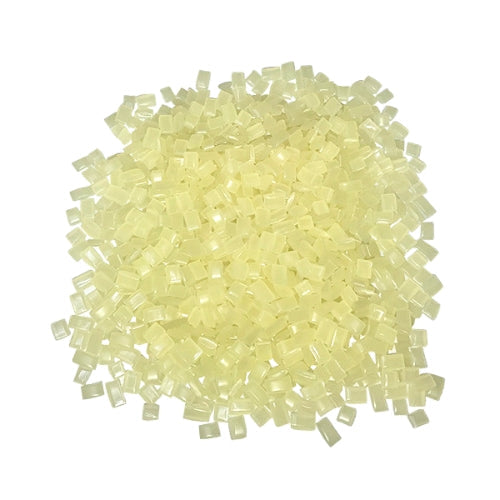
These biodegradable hot glue pellets come in a 44-pound carton for companies using a lot of hot melt. The adhesive has a high viscosity and is often used for manual packaging applications. It should be stored away from direct sunlight in temperatures below 30°C.
3. Glue Sticks

We offer both ½" biodegradable glue sticks for low adhesive outputs and ⅝" biodegradable hot melt glue sticks for high adhesive outputs. The ½" sticks are great for more precise applications and smaller packaging needs. In contrast, the ⅝" sticks are better for use with heavier substrates or larger materials.
4. Slugs

Compared to traditional hot melt, these more environmentally conscious glue slugs are made for high-volume, industrial packaging applications. They come in 1¾ inch (or 43 mm) pale amber slugs in a 22-pound case.
Have More Questions?
Looking for a more environmentally friendly glue solution for your company? If you are not sure which product to use or just want to learn more about compostable and biodegradable adhesive glues as a whole, we want to help. Reach out to us today to speak with an adhesive expert.
Interested in distributing these products? We are also looking for new distribution partners for the biodegradable hot melts mentioned above. Learn more.
Sources:
- Our World in Data (2024). Packaging is the source of 40% of the planet’s plastic waste
- MarketsandMarkets (2025). Sustainable Adhesives Market
- Shorr (2025). The 2025 Sustainable Packaging Consumer Report